




What are the rules of poker? At their core, the poker game rules are straightforward: win the pot by making the best five-card hand at showdown, or get all your opponents to fold before it gets there. That is the whole game. Everything else — the betting rounds, hand rankings, positions, and variants — is built on top of that one idea.
For beginners, the basic poker rules are easiest to learn through Texas Hold'em. It is the most popular format worldwide, used in the World Series of Poker, most online cardrooms, and home games everywhere. The poker rules for beginners in Hold'em are simple enough to learn in an afternoon — but the strategy runs deep enough to last a lifetime.
Most standard formats use a 52-card deck with no jokers. Games involve betting rounds, a shared pot, and six core decisions: check, bet, call, raise, fold, or go all-in. Texas Holdem poker rules and Omaha poker rules share the same betting structure, but differ in how hole cards are used. In this guide, we cover everything from hand rankings to variant rules, online poker rules, and where to start playing.
How a Poker Hand Works: Deal, Betting Rounds, and Showdown
Understanding the poker game rules starts with the flow of a single hand. Before any cards are dealt, the table establishes the dealer button, small blind, and big blind. The button marks who is notionally dealing and rotates clockwise each hand. The small blind and big blind post forced bets — this is where the pot starts.
Once the blinds are in, each player receives private cards. In Texas Hold'em that is two; in Omaha it is four. After that, the hand moves through betting rounds separated by community card deals. A complete hand follows this sequence:
- The button is set; blinds and any antes are posted.
- Players receive their private (hole) cards.
- First betting round begins — players check, call, raise, or fold.
- If no one raises, the big blind can check or raise when the action returns
- Community cards are dealt (if the variant uses a board).
- Additional betting rounds follow after each new community card.
- If two or more players remain after the final bet, the hand goes to showdown.
A hand does not always reach showdown. If one player bets and everyone folds, they take the pot without showing their cards. This is one of the most important nuances in the basic poker rules: many pots are won through aggression, not by holding the best hand.
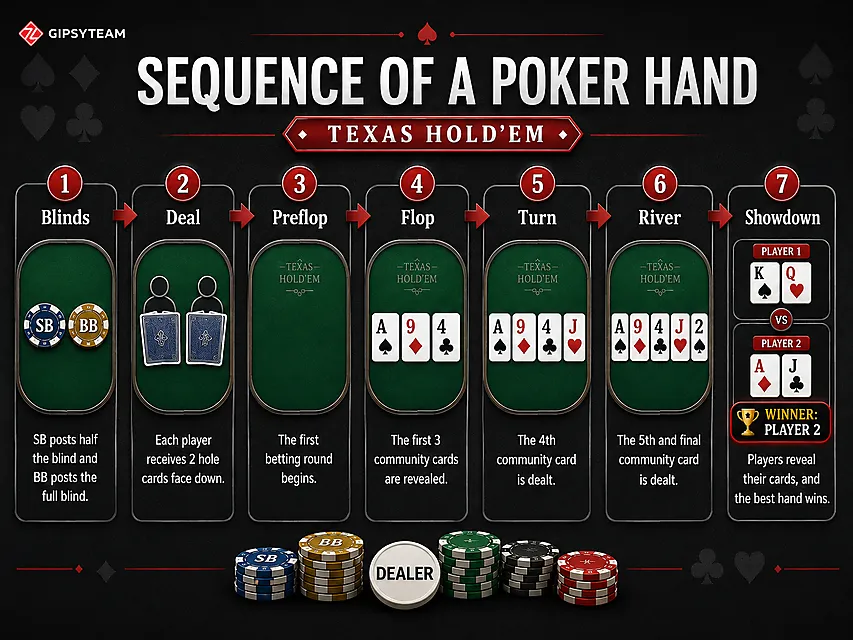
Before the first betting round, forced bets are posted: in blind games, the small blind and big blind post their blinds; in ante games, all players may post an ante, and some formats use both. When showdown does happen, players reveal their cards. The best five-card combination wins. In Texas Hold'em, if there was a bet on the final street, the last aggressor shows first. If no bet was made on the river, the first active player left of the button shows first.
Poker Hand Rankings: From High Card to Royal Flush
One of the first things any beginner needs to memorize is the hand ranking system. It is the same across nearly all high-hand poker formats — Texas Holdem poker rules, Omaha poker rules, and most other variants all use this standard ladder. Suits carry no relative value; two hands of the same rank split the pot.
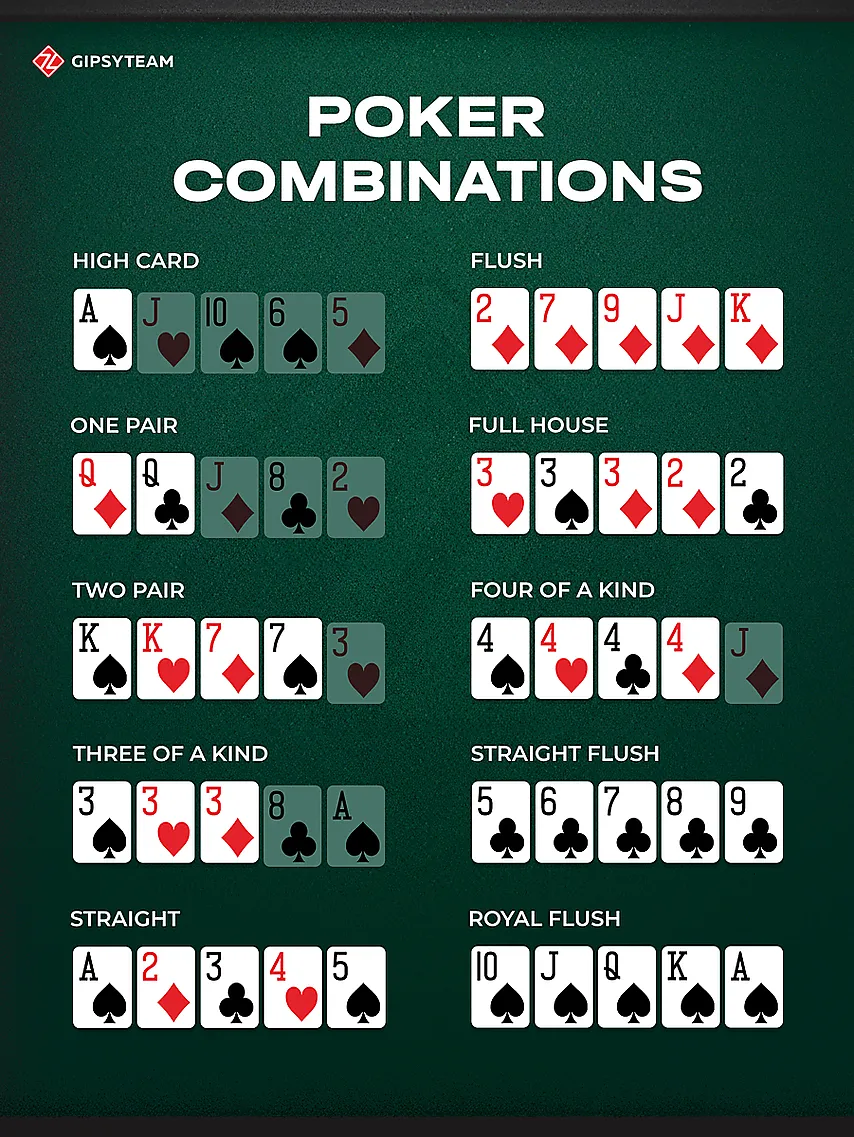
A few details worth remembering: an ace can serve as both the highest card in a royal flush and the lowest card in a straight (A-2-3-4-5, also called a wheel). Kickers — the unpaired cards that accompany a hand — act as tiebreakers when two players hold the same category. For a complete breakdown, see our guide on how to remember poker hands.
Positions, Blinds, and Antes: The Poker Game Rules That Shape Every Decision
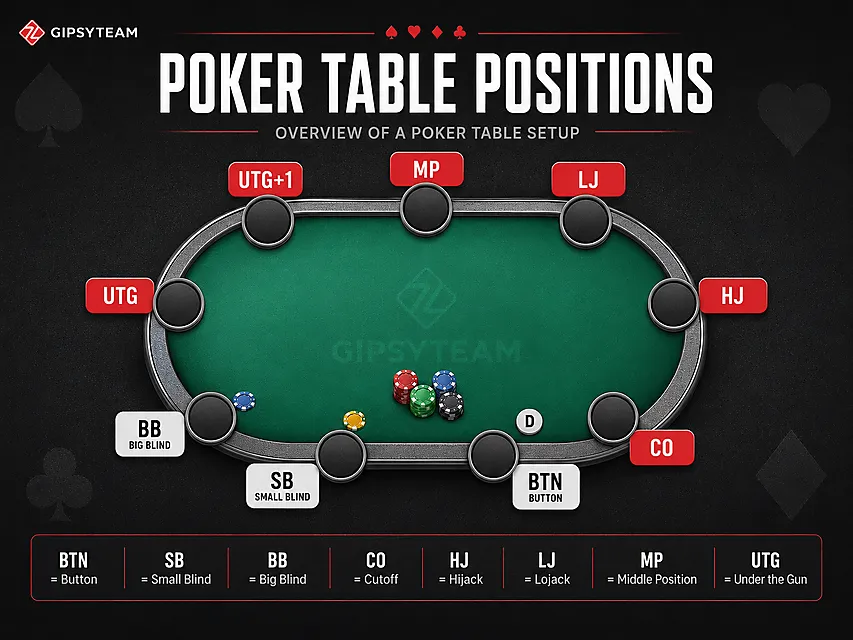
Position is one of the most underappreciated concepts in the basic poker rules for new players. Where you sit relative to the dealer button determines when you act — and acting later in a betting round means more information. You can see what opponents do before you decide.
Positions are commonly named as follows:
- UTG (Under the Gun): first to act before the flop; least information, most caution required
- MP (Middle Position): moderate information; hand selection still fairly tight
- CO (Cutoff): one seat right of the button; wide range possible with reads from earlier players
- BTN (Button): acts last post-flop; widest playable range; biggest positional advantage
- SB (Small Blind): forced to post half a blind; acts second-to-last before the flop, first post-flop
- BB (Big Blind): posts the full blind; acts last before the flop and may check if no one raises, or raise when action returns.
Blinds are mandatory bets that create an initial pot and ensure there is always something worth competing for. Some games also use antes — smaller forced contributions paid by every player at the table, or sometimes just by the big blind. Antes become common in tournaments as blind levels increase and encourage more action.
For beginners, the practical takeaway from the poker game rules on position is this: a hand like J-9 suited might be playable from the button but should likely be folded from UTG at a full table. Position does not change your cards — it changes their value.
Betting Actions in Poker: Check, Bet, Call, Raise, Fold, and All-In
A lot of early confusion with the poker rules for beginners comes from the action vocabulary. In practice, every decision you make at the table falls into one of six categories.
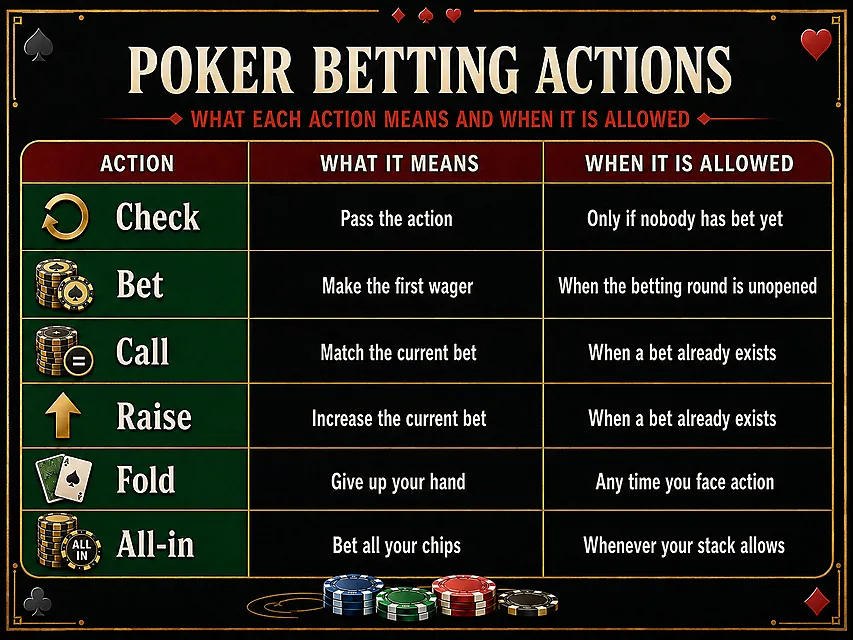
Checking is only possible if nobody has bet ahead of you in the current round. Once a bet is out, checking is no longer an option — you must call, raise, or fold. Going all-in means committing every chip in front of you. If you have fewer chips than the opponent's bet, you put in what you have and a side pot is created for the remaining action between other players. You can only win up to the amount you matched from each player.
In tournament play, the minimum raise must equal at least the size of the previous raise in the same round. A short all-in — where a player commits their last chips but falls below the minimum raise — is accepted but does not reopen the betting for players who already acted, unless another player raises on top.
Texas Holdem Poker Rules: Preflop, Flop, Turn, River, and Showdown
Texas Holdem poker rules are the foundation for understanding most modern poker. Each player receives two private hole cards. Five community cards are then dealt in three stages: three on the flop, one on the turn, one on the river. The goal is to make the best five-card hand from any combination of hole cards and board.
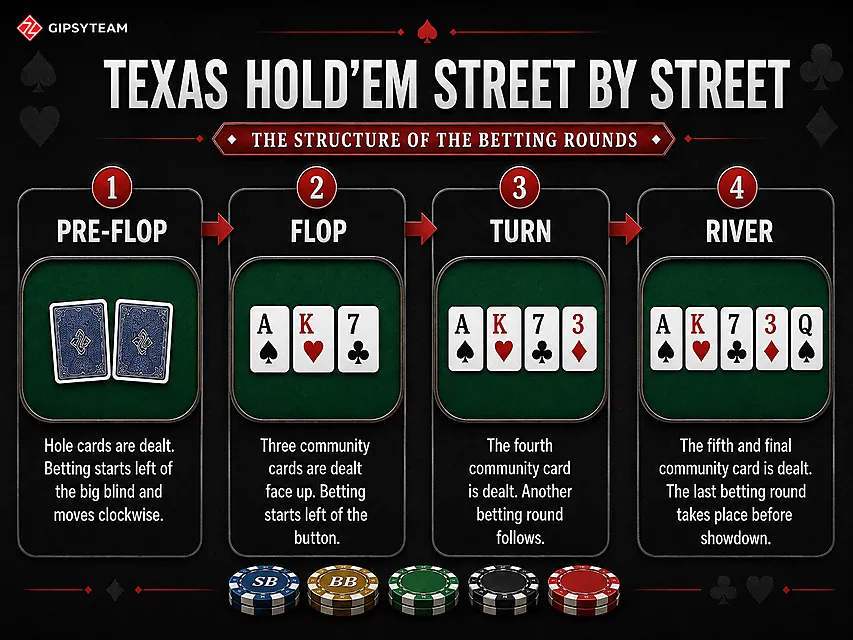
Unlike Omaha, Texas Hold'em gives you complete flexibility: you can use both hole cards, just one, or neither if the board alone makes the best hand. This flexibility makes the game simultaneously easier for beginners and more nuanced for experienced players.
The street-by-street structure of Texas Holdem poker rules:
- Preflop: hole cards are dealt; betting starts left of the big blind, moves clockwise
- Flop: three community cards dealt face-up; betting starts left of the button
- Turn: fourth community card; another betting round
- River: fifth and final community card; last betting round before showdown
If everyone folds at any point, the hand ends. The last player standing takes the pot without a showdown. When two or more players remain after the river betting round, hands are revealed and the best five-card combination wins.
Preflop, decisions depend on starting hand strength, position, and opponent tendencies. Postflop is where Texas Holdem poker rules really test a player's judgment: reading the board, calculating pot odds, assessing draws, and deciding when to bet for value versus when to check or fold.
Poker Variants: Omaha, 5 Card Draw, 7 Card Stud, Razz, and HORSE
Once you have the basic poker rules down, the natural next step is exploring other formats. Each variant has its own character — different hand reading challenges, different betting dynamics, and different skill sets that separate winning players from the field.
| Variant | Hole Cards | Community Cards | Key Rule |
|---|---|---|---|
| Texas Hold'em | 2 | 5 (flop/turn/river) | Use 0–2 hole cards |
| Omaha | 4 | 5 (flop/turn/river) | Must use exactly 2 hole + 3 board |
| 5 Card Draw | 5 | None | May discard and draw new cards |
| 7 Card Stud | 7 (mix face-up/down) | None | No community cards; mixed exposure |
| Razz | 7 (mix face-up/down) | None | Best low A-to-5 hand wins |
| HORSE | Rotates | Depends on round | Cycles through 5 variants, fixed-limit |
Omaha poker rules are the most common starting point after Hold'em. Players receive four hole cards, but the key restriction is that exactly two must be used with exactly three board cards. This sounds simple, but it dramatically changes hand reading — nut flushes and nut straights are far more common, and the best hand at showdown is often much stronger than in Hold'em.
5 Card Draw poker rules: each player receives five private cards. After the first betting round, players may discard any number of cards and draw replacements from the deck. A final betting round follows, then showdown. No community cards are used. This is often the first format people encounter in home games — intuitive, social, and fast.
7 Card Stud poker rules: no community cards, no dealer button. Each player receives seven cards — two face-down and one face-up to start, then three more face-up, then a final card face-down. Betting order is determined by the exposed cards. The player showing the highest or lowest card (depending on the round and variant) acts first. Reading exposed cards is a central skill.
Razz inverts the standard ranking: the best ace-to-five low hand wins. Aces are always low. Straights and flushes do not count against you. The strongest possible Razz hand is A-2-3-4-5 (the wheel). HORSE cycles through Limit Hold'em, Omaha Hi-Lo, Razz, Seven Card Stud, and Stud Hi-Lo on a rotating basis — usually one round per orbit at the table.

Playing With GipsyTeam: Rooms, Apps, and Bonuses
The online poker rules are essentially the same as live poker rules — the hand rankings, betting structure, and action sequence do not change. What changes is the interface: you click buttons instead of tossing chips, and the software handles shuffling, pot management, and side pot calculations automatically.
A few practical notes on online poker rules specific to the digital environment: most rooms enforce a shot clock or time bank to keep games moving; all-in protection is standard (your hand cannot be folded due to a disconnection if you are all-in); and multi-tabling — playing several tables simultaneously — is allowed on most platforms, though it requires practice to manage well.

GipsyTeam provides guides, room reviews, bonus comparisons, and beginner resources for players exploring online poker. Whether you are looking at cash games, MTTs, Sit & Go formats, or mobile apps, the site covers room-specific conditions, exclusive promo codes, freeroll schedules, and cashier options. Understanding the online poker rules of a specific room — withdrawal limits, KYC requirements, rake structures, rakeback — is just as important as knowing the poker game rules themselves before depositing.






Recommended starting points include BC Poker, WPT Global, and CoinPoker — all GipsyTeam partners with exclusive registration bonuses and freeroll access through the site. Terms are updated regularly, so always check the current offer before signing up. For players new to the game, starting with low-stakes tables or free tournaments is the safest way to apply what you have learned. For a broader comparison, see our guide to the best online poker sites.


- GipsyTeam's unique promotions
- Help with deposits and cashouts
- Access to private freerolls
- Round-the-clock support
- Уникальные акции от GipsyTeam
- Помощь с депозитами и кешаутами
- Доступ в закрытые фрироллы
- Круглосуточная поддержка
Frequently Asked Questions About Poker Rules
Q: What are the rules of poker for a complete beginner?
The most important thing to understand first is what are the rules of poker at a basic level: the goal is to win the pot by holding the best five-card hand at showdown or by making every opponent fold. Start with Texas Hold'em — the poker rules for beginners are clearest there, and there are more learning resources available for that variant than any other.
Q: What are the basic poker rules for betting?
On each betting round, you can check (if no bet has been made), bet (open the round), call (match a bet), raise (increase it), or fold (give up your hand). The basic poker rules require all active players to either match the highest bet or fold before the round is complete.
Q: How do Texas Holdem poker rules differ from Omaha poker rules?
In Texas Hold'em, you receive two hole cards and can use zero, one, or both. In Omaha, you receive four hole cards and must use exactly two — no more, no less — combined with exactly three board cards. This single rule creates very different hand reading dynamics between the two formats.
Q: Can you win without showing your cards in poker?
Yes. If all opponents fold at any point during the hand — before or after community cards are dealt — you win the pot immediately without having to reveal your hand. This is true under the poker rules for beginners and experienced players alike.
Q: What is a blind in poker?
A blind is a forced bet posted before cards are dealt. Most games with a dealer button use a small blind and a big blind. The small blind posts half the minimum bet; the big blind posts the full minimum bet. They ensure there is always something at stake before voluntary action begins.
Q: Is the ace high or low in poker?
In high-hand games, an ace can serve as both the highest card (in a royal flush or A-K-Q-J-10 straight) and the lowest card (in an A-2-3-4-5 straight, called a wheel). In lowball and Razz, the ace is always treated as a low card.